

An internal Hamas document proposed explosions around Gaza shelter centers and deliberate chaos among displaced civilians to help commanders and operatives escape Israeli forces. One passage spells out the connection: disorder among the displaced would interfere with control of the area and allow designated personnel to evacuate.
The IDF made the April 2024 document public on 19 October 2026. Its title refers to securing shelter centers. The provisions about who would leave them reveal the purpose of the proposed evacuation arrangements.
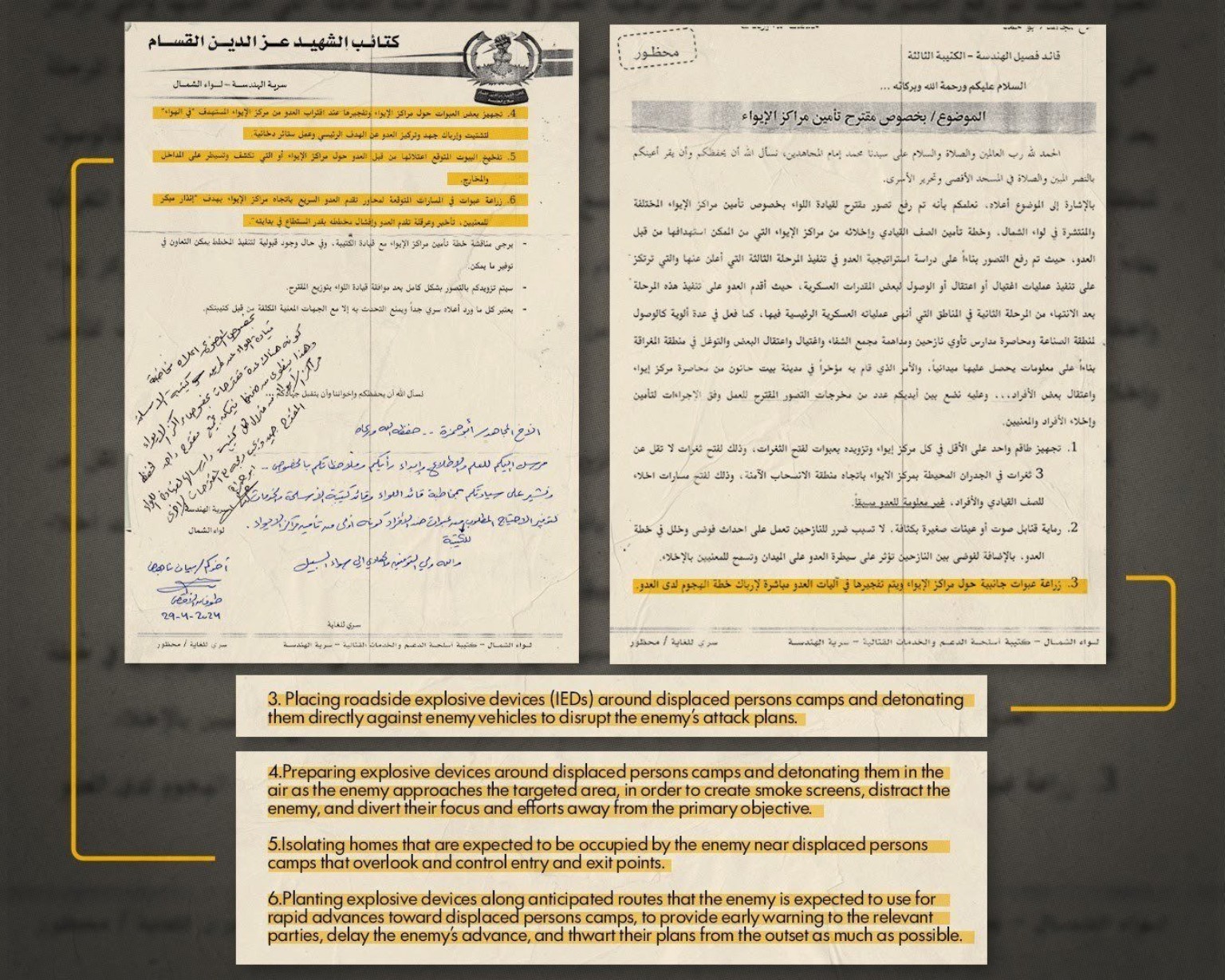
The April 2024 Hamas document published by the IDF on 19 October 2026. Source: Israel Defense Forces. Open the full document image.
Turning civilian disorder into cover for escape
The document proposes sound grenades or small explosive devices to disrupt an approaching force and produce confusion among people sheltering at the centers. That reaction would help others get away.
Those others are identified elsewhere as leadership personnel and members designated for evacuation. The text distinguishes them from the displaced civilians. That separation matters because the proposal gives the two groups different roles: one group would be caught in the disorder, while the other would use the disruption to leave.
The relevant passage instructs that the diversionary devices should not harm displaced people. Even with that instruction, the proposed military advantage depends on deliberately unsettling civilians at the place where they have sought protection.
Other provisions introduce explosives around those same places. The diversion involving civilians is part of a broader set of preparations intended to delay Israeli forces and make escape easier.
The IDF said the document demonstrated Hamas’s willingness to put Gaza civilians at risk to protect its own leadership and operatives.
Explosives around the shelters, traps in nearby buildings
The Arabic pages describe explosive devices around shelter centers to strike approaching Israeli vehicles and disrupt an attack. Separate explosions would distract the force, shift attention away from the main objective and create smoke screens.

The proposal extends into the surrounding buildings. Houses that Israeli troops might occupy, including those overlooking entrances and exits, would be booby trapped. Devices on anticipated advance routes would provide warning and slow the approaching force.
The military preparations would therefore reach across a civilian refuge and its surroundings. Roads could delay movement. Buildings could become traps. Noise, smoke and disorder could make it harder for the advancing force to maintain control.
The people gathered at the shelter would remain in that environment. The instruction against harming them in one diversion passage does not remove the danger introduced by the wider plan.
The evacuation provisions explain what Hamas personnel were meant to do while the approaching force faced those disruptions.
Routes out while the approach was disrupted
The document discusses preparing passages through shelter boundaries toward withdrawal areas. Their intended users are the leadership echelon and personnel. The routes would offer a further advantage: the approaching force would not know them beforehand.
That connects the explosives and diversions to a destination. Delays would buy time. Distraction would draw attention elsewhere. Prepared exits would give designated personnel a way to use that opening.
The Arabic term used for the sites means shelter centers. It can include buildings housing displaced people, rather than only tent camps. References to walls, houses and entrances concern the physical places where people were sheltering and the spaces around them.
The pages bear Qassam Brigades headers and identify an engineering company within Hamas’s Northern Brigade. A handwritten notation reads 29 April 2024. Closing instructions call for discussion with battalion command and refer to brigade approval before the complete concept is supplied.
The released pages describe proposed measures; they do not establish whether those measures were subsequently implemented.
The purpose set out in them is clear: obstruct the forces coming toward the shelter area and facilitate the departure of commanders and personnel. The passage on displaced civilians assigns their confusion a place in that effort to escape.