
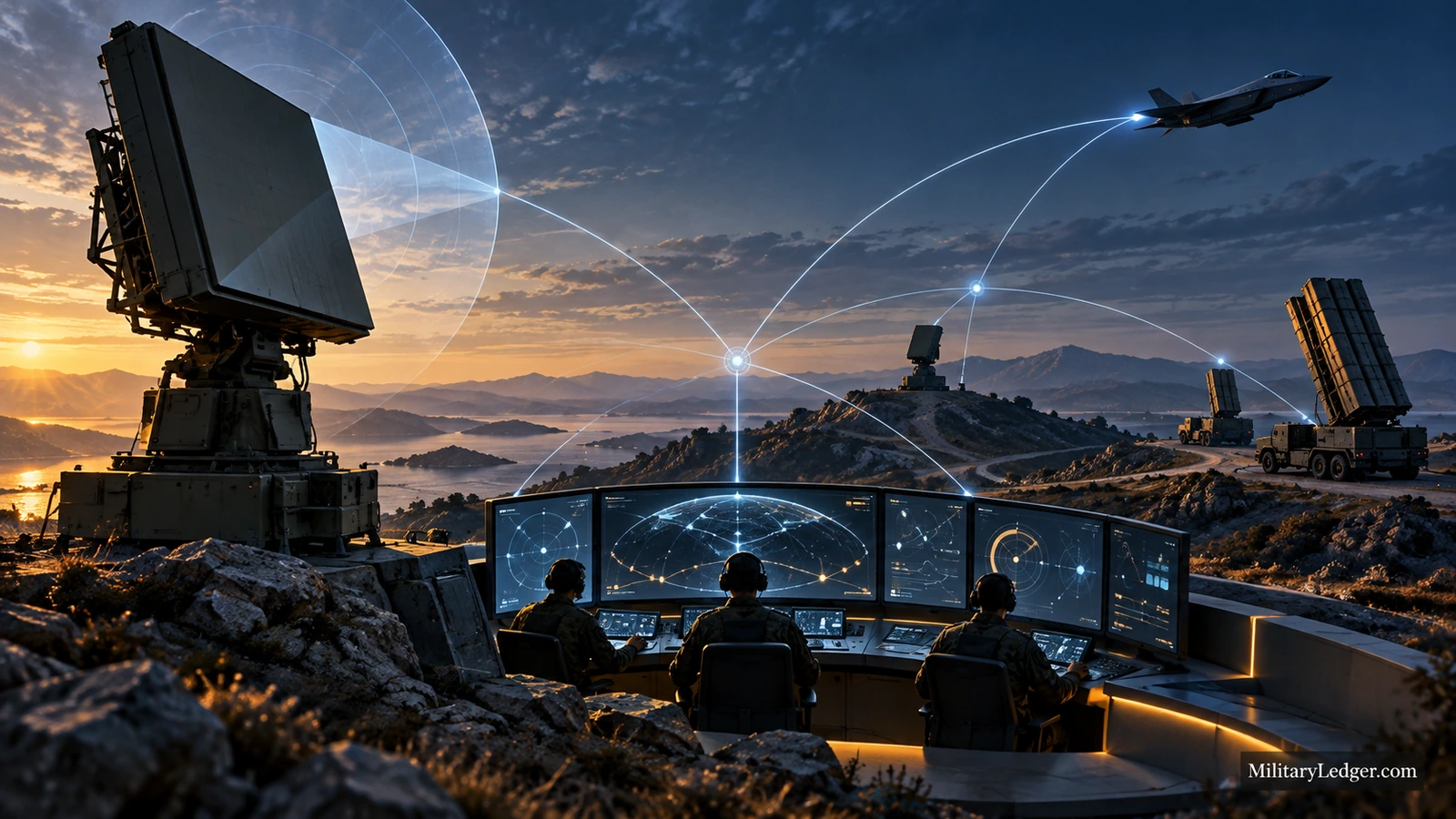
An interceptor launch is the visible end of a longer process. Before a defensive weapon can be used, a system must detect a possible threat, maintain a useful track and support a decision about what to do next.
Layered air defense combines those tasks with defensive capabilities suited to different threats. Integration connects the parts; layering gives them complementary roles. Neither term promises that every threat will be stopped.
The first layer is information
Sensors detect objects and contribute information about their movement. Command-and-control systems help combine that information into a usable picture. A detection, however, is not automatically a complete identification or a reliable prediction of where an object will go.
Tracking means maintaining information over time. Identification concerns what the object is. Assessment concerns the danger it presents. These functions are connected, but they answer different questions.
NATO's account of integrated air and missile defense describes an interconnected system of sensors, command-and-control assets and weapons. That architecture matters because a defensive weapon cannot compensate for every gap in the information supporting its use.
Different threats call for different capabilities
Aircraft, small uncrewed systems, cruise missiles and ballistic missiles do not present the same problem. They differ in speed, size, flight behavior and the conditions in which they can be detected and engaged. The distinctions between ballistic, cruise and hypersonic weapons help explain why one defensive system cannot be assumed to cover every role.
Layering places complementary capabilities within a broader architecture. Some operate over shorter distances or at lower altitudes; others address different parts of the threat spectrum. The mix can include defensive aircraft, missiles, guns and other counter-air or counter-drone capabilities, depending on the force and mission.
The layers are not necessarily neat concentric circles. Their usefulness depends on the threats, the protected locations, available information and the conditions of an engagement. A simple diagram can introduce the idea, but it cannot establish the coverage of a real deployment.
Connection matters as much as equipment
Buying several systems does not by itself establish that they function as one integrated defense. The information they exchange, the organizations operating them and the procedures governing their use matter too.
Integration can help different units work from a shared picture and coordinate their roles. The details vary across countries and alliances. A report about a new radar, launcher or command system should therefore explain what was actually added, rather than treating each purchase as a complete new shield.
This is also why air defense and missile defense overlap without becoming identical terms. The first can describe a broad mission against airborne threats. The second focuses on missile threats. An integrated architecture can bring those responsibilities together.
An interception percentage needs a definition
An announced success rate is difficult to interpret without knowing what was counted. Was the denominator all launches, detected objects, threats assessed as dangerous, engagement attempts or defensive missiles fired? Those are different measures.
The numerator needs an explanation too. What counted as a successful intercept, who assessed it and over what period? Were several defensive systems or partner forces involved? A combined result should not be casually reassigned to one named weapon.
These are reading questions, not reasons to dismiss every official figure. They help a reader understand the scope of a claim. Two percentages should only be compared after their definitions and circumstances are understood.
Test results and combat accounts measure different things
A test report can describe performance against specified conditions. A combat statement may describe a mixed sequence of events with less public information about what happened. Both can be useful, but their figures are not automatically comparable.
A claim about one interceptor should also be distinguished from a result achieved by a wider network. Sensors, aircraft, partner forces and several defensive systems may contribute to the same reported outcome. A headline percentage cannot tell the reader how much each element contributed unless the underlying account provides that information.
Range is not a protective radius
A published maximum range describes a capability under particular conditions. It does not establish an identical circle of protection against every object approaching from every direction.
Target behavior, altitude, terrain, sensor information and the actual mission can affect the relationship between a weapon's stated reach and the area defended. Reporting should explain that limitation at a general level, without presenting nominal specifications as a map of real-world protection.
The result on the ground also matters. Saudi authorities' account of interception debris in Riyadh illustrates why an announced interception and the absence of civilian harm are different claims.
A useful air-defense report therefore describes the whole chain: what was detected, what response was reported, how the result was measured and what effects were documented. The launch is one event within that chain.