
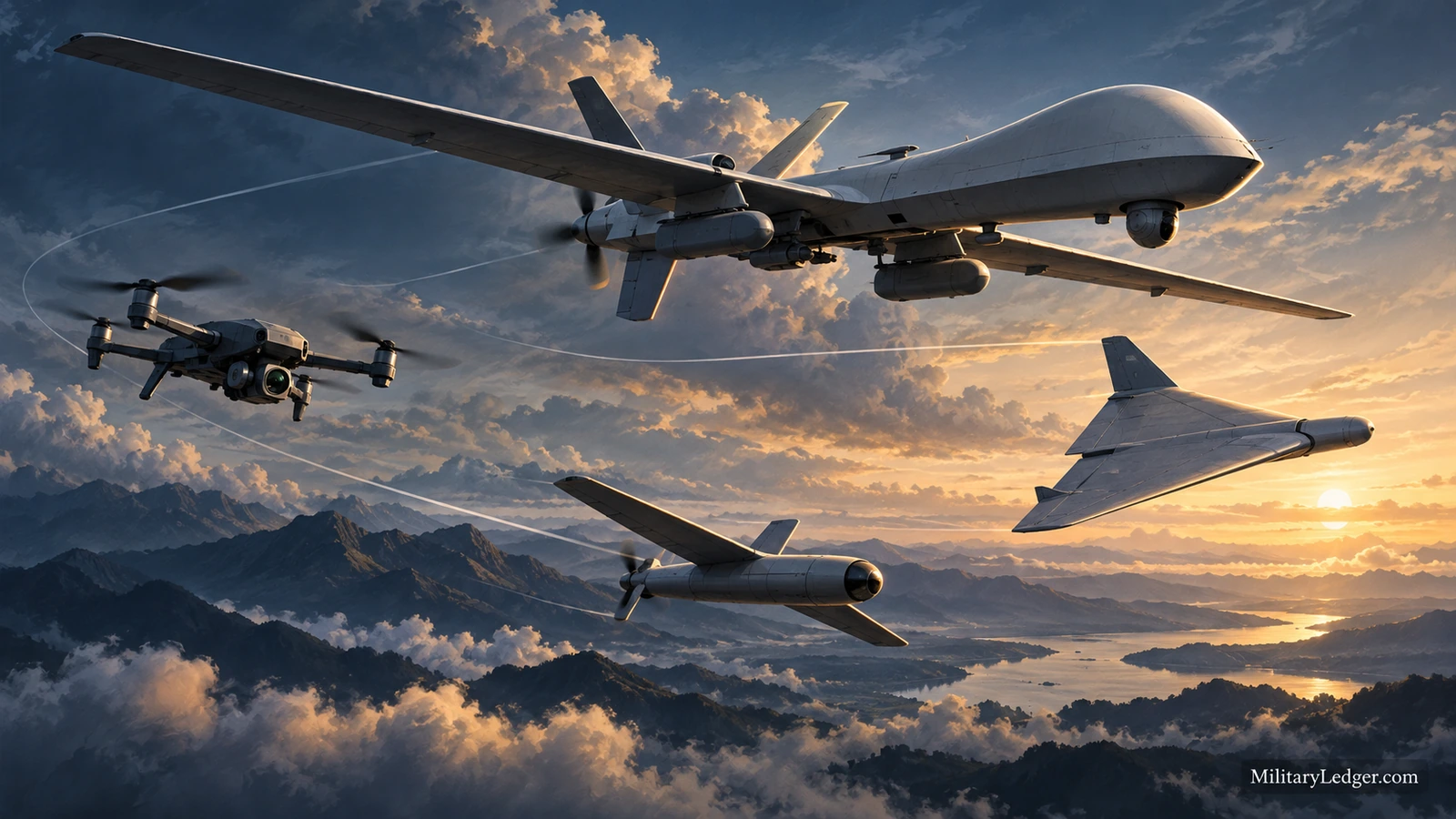
The word drone tells a reader remarkably little about a military system. It does not establish whether the vehicle returns, whether it carries a weapon or whether a person selects its target.
Those questions are more useful than the label alone. A clear description identifies the platform's role, the way it is controlled and the function being discussed. It also separates the aircraft from the wider system that makes it usable.
An aircraft is one part of a system
An uncrewed aircraft is the airborne vehicle. An uncrewed aircraft system includes the supporting elements needed for its operation, which can include control equipment and communication links.
That distinction matters when a contract or military announcement gives a quantity. A purchase of several systems does not necessarily mean the same number of aircraft. The package may include multiple vehicles, control stations, support equipment or training. The announcement must define the unit being counted.
Terminology also varies. Unmanned and uncrewed are both used, while remotely piloted emphasizes the presence of a human pilot operating from elsewhere. None of these terms, standing alone, establishes a weapon's decision-making functions.
Reconnaissance and armed aircraft have different jobs
Some military drones carry sensors to observe an area and return with or transmit information. Other remotely piloted aircraft carry weapons that a human operator decides to use. A platform can perform more than one role, so a list of rigid, mutually exclusive categories can be misleading.
The same caution applies to physical appearance. A photograph may show a vehicle's broad shape, but it cannot reliably establish its software functions, control arrangements or operating mode. Those details need documentation tied to the relevant model and variant.
Nor does the presence of a camera prove a reconnaissance-only role. What matters is the documented function of the system in the report being written.
One-way attack systems and loitering munitions overlap
A one-way attack system is intended to be expended in an attack. The phrase describes what happens to the platform, but does not by itself explain how it finds or selects a target.
A loitering munition is commonly described as a weapon designed to remain available in an area before attacking. The duration, sensors, communications and degree of human control differ between designs. The label should not be used to assume every product has identical capabilities.
The categories can overlap. They are not automatic synonyms. If the available evidence supports only a one-way role, calling a system a loitering munition may add a capability that has not been established. When a source uses a disputed classification, explain the relevant function instead of letting the name do all the work.
Automated flight is not autonomous target selection
A vehicle can follow a programmed route or use automated flight functions without independently deciding whom or what to attack. Automation in navigation is a different question from autonomy in the use of force.
The International Committee of the Red Cross's explanation of autonomous weapon systems focuses on systems that select and apply force without further human intervention after activation. That is a functional distinction. It does not mean every uncrewed aircraft or remotely operated armed drone falls into the category.
Claims about artificial intelligence need the same precision. Ask which task the technology performs. Image processing, flight control and target selection are different functions, with different implications. The phrase AI-powered does not identify which one is involved.
Size is another distinction, not a complete classification
A small aircraft and a large remotely piloted platform may both carry sensors, while platforms of similar size can serve different purposes. Weight and dimensions can be useful descriptive facts, but they do not replace the questions about role and control.
The word drone is also used outside aviation, including for vehicles on or under water and on the ground. This guide concerns aircraft and associated weapons. Applying an aviation term such as UAS to every uncrewed vehicle would lose that distinction.
Read quantities and capabilities together
An announcement that a force ordered drones is only a starting point. Which models were ordered? How many aircraft and supporting systems are included? What stage has the purchase reached? An arms-sale announcement is not a delivery, and a delivery is not proof of every advertised capability.
For combat footage, the questions are narrower still. A clip may show an airborne object or a visible impact without establishing its model, control mode or target-selection process. Reading battlefield claims requires keeping those conclusions separate.
The most useful drone description therefore names the role and the supported functions. It tells readers what the system is reported to do, who controls the relevant decisions and which details remain unknown.